Before the timetable
As Earth turns, the sun reaches its highest point earlier in the east. Two towns could each set a perfectly sensible clock by the sun and still disagree about the time.
When each town set its clock by the sun, noon in one town could be minutes away in the next. Railroads needed passengers and crews across many towns to agree on when a train would leave.
Read the timetable ↓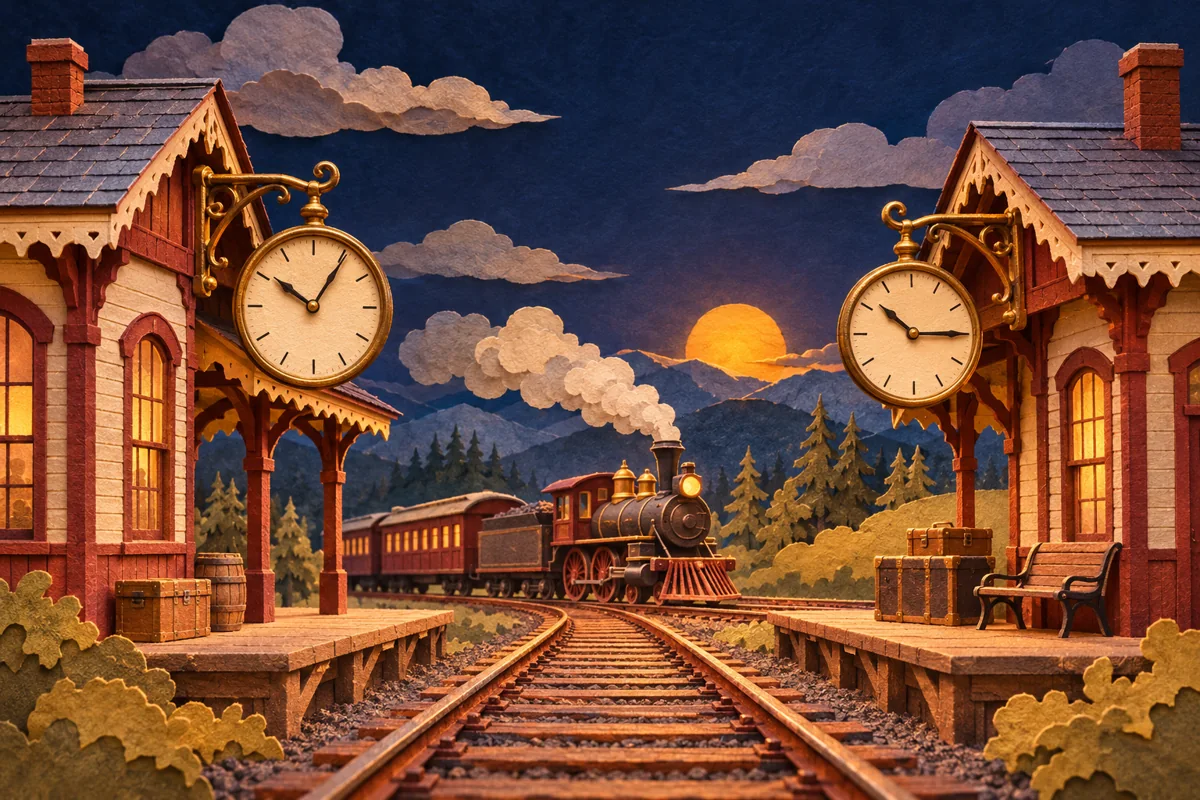
Imagine two towns that set their clocks by the sun. You board in West Town at 11:44. At that same instant, it’s already noon in East Town.
| Station | Local clock |
|---|---|
| Depart West Town | 11:44 |
| Arrive East Town | 12:30 |
Read both times on East Town’s clock. You left at noon and arrived at 12:30. The ride took half an hour. The extra 16 minutes belong to the clocks.
As Earth turns, the sun reaches its highest point earlier in the east. Two towns could each set a perfectly sensible clock by the sun and still disagree about the time.
North American railroads adopted regional standard time. In some cities, the old clocks had already reached noon when they were set back. People watched noon arrive a second time.
Once stations in the same zone agreed on the time, a passenger could subtract departure from arrival directly. U.S. federal law formalized standard time in 1918.
A train leaves at 11:50 Central and arrives at 1:20 Eastern the same day. How much time passes?
Thirty minutes. At departure it’s already 12:50 Eastern. Count forward to 1:20 Eastern.